
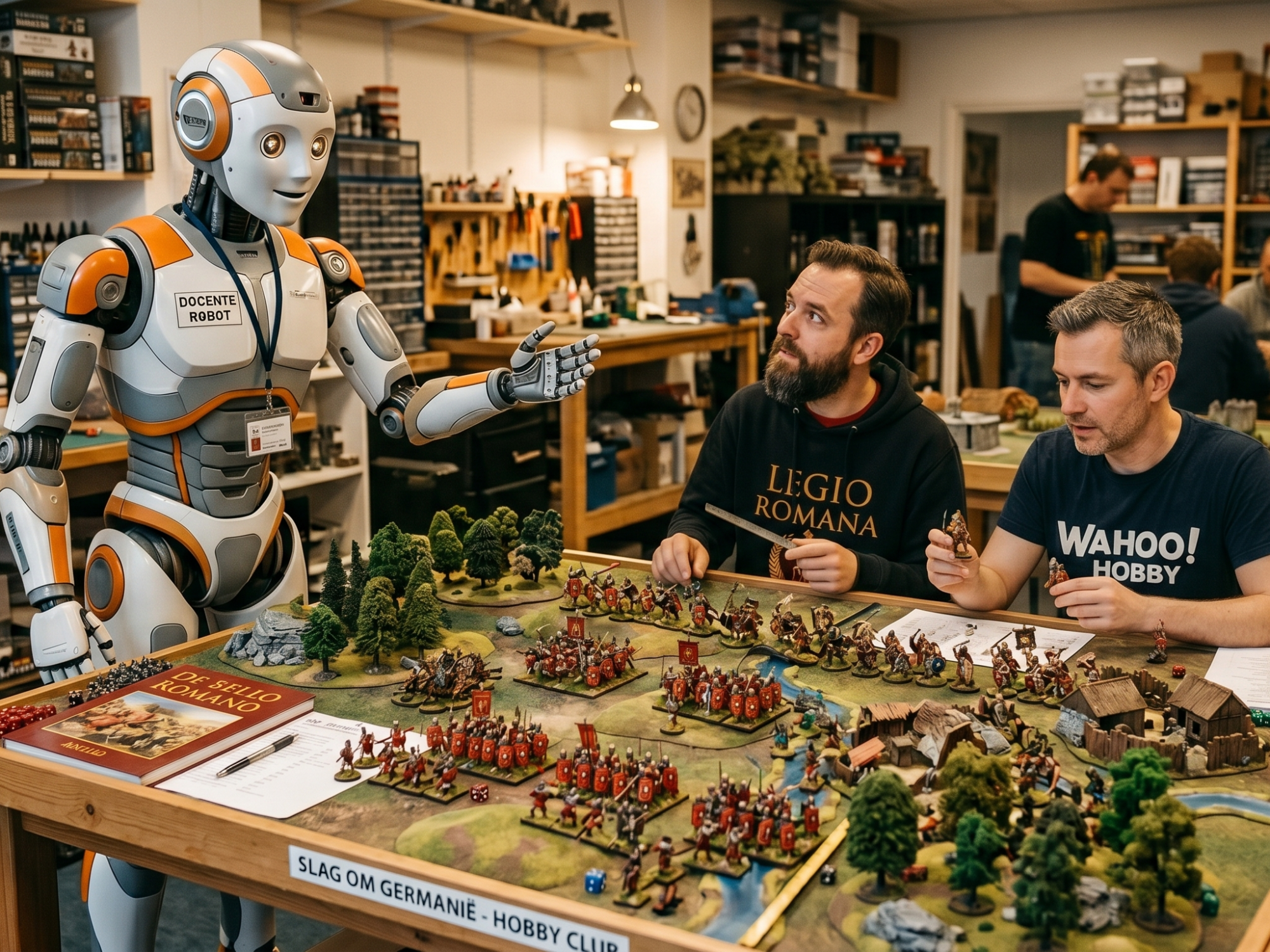
I have a confession. I spent twenty years as a criminal defence lawyer, and since 2023 I’ve been representing the state, as state counsel, before immigration courts. In both roles, the job is essentially the same: read a massive pile of rules, figure out what they mean, and apply them to a specific situation. The rules change constantly, edge cases multiply, and somewhere in a footnote there’s always a clarification that overturns what you thought you knew.
It will surprise no one that I started trying AI chatbots for legal work fairly early. I reviewed several apps for a law journal. Feed it the regulation, ask a specific question, get a structured answer. Not a replacement for actual legal judgment — but a useful first pass, a way to quickly locate the relevant clause, or to check whether you’ve missed something obvious.
Then one day I looked at the 200-page Mortem et Gloriam rulebook sitting on my desk and thought: these are also rules.
The Setup
Mortem et Gloriam (MeG) is a wargame covering ancient and medieval warfare. It’s well-designed, historically grounded, and has a learning curve steep enough to give you a nosebleed. I’ve played a handful of games in Pacto format — the streamlined entry-level version — and I’m still at the stage where I need to look things up constantly. Not because the rules are badly written, but because there are a lot of them, they interact, and my opponents have an annoying habit of doing things I didn’t expect.
I use Claude Cowork — Anthropic’s desktop AI tool — as my rules tutor. The setup is simple: you give it the relevant files, write some instructions, and then ask questions.
My setup includes:
- The full MeG rulebook
- The Quick Reference Sheet
- The official Clarifications document (because there are always clarifications)
- An introductory overview of the game’s core systems
- A file with 24 historical army lists in Pacto format, covering 12 matched pairs based on famous battles
Once those files are in place, Claude can answer questions like “what happens when skirmishers are caught by cavalry in the flank” with reference to the actual rule text — not a vague recollection, but a citation.
Romans vs Dacians: A Field Test
Today I played Early Imperial Romans against Dacians at my club, the Amsterdam6shooters. My opponent was Henrique. I like Portuguese people. The one exception is when they beat me at wargames, at which point I like eating Portuguese.
The scenario is based on Trajan’s campaign at Sarmisegetusa (106 CE), and both armies are included in the sample lists I gave Claude.
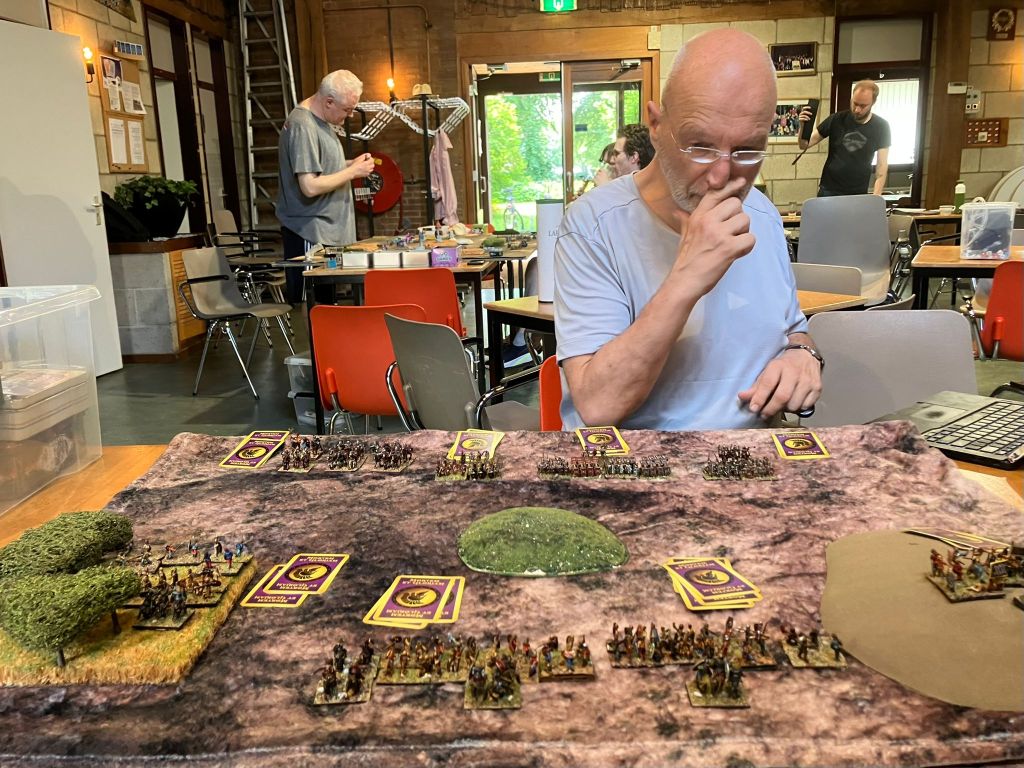
Before the game, I used Claude to go through the lists: what does this army want to do, where are its vulnerabilities, what should I watch out for? The Dacians have a nasty combination of fast warbands, decent shooting, and Falx-armed infantry that will ruin your day in close combat. The Romans have discipline, good heavy infantry, and enough auxiliaries to cover the flanks — if they’re deployed correctly.
During the game itself, I went back to Claude twice. Once to check whether a specific interpenetration move was legal. Once because we weren’t sure how Shove interacted with a particular terrain situation. Both times I got a clear answer with the relevant rule passage quoted.
The game ended with the Romans having taken a serious beating. Time ran out before it officially collapsed, but let’s say the eagles were flying low. Claude’s pre-game briefing had been accurate — I just didn’t execute it particularly well. Henrique did. I went home hungry.
The Problems (Because There Are Always Problems)
Let me be honest about the friction points.
PDF conversion is a mess. The official MeG army lists come as PDFs, and PDF-to-text conversion tends to produce something that looks like a cat walked across a keyboard. Tables get mangled, column data ends up on the wrong rows, numbers go missing. I spent a session having Claude restructure the army list file from scratch — parsing the original PDF page by page, rebuilding clean markdown tables, fixing two typos that were already in the source document. That session was more digital administration than wargaming.
The lesson: clean your source files before you rely on them. Garbage in, garbage out. If your rules document converts cleanly to text, great. If it doesn’t, budget time to fix it, or the AI will confidently cite column B when it means column D.
Speed varies. Claude processes large files, and sometimes there’s a pause. If you’re mid-game and need a quick answer, that pause is annoying. It’s not a dealbreaker, but it’s not the same as having a human opponent who just knows the rules.
Token costs. Different AI models have different price points. Claude offers several models — Sonnet is fast and good; Opus is the most capable but also the most expensive. For rules Q&A, Sonnet is more than sufficient. Don’t burn your token budget on Opus for something like “how many bases in a Skirmisher SUG.”
It’s Not Just Claude
The same approach works with other AI assistants. ChatGPT (OpenAI) and Gemini (Google) both let you upload documents and ask questions about them. The specific interface differs — in Claude Cowork you can set up a persistent project folder; in ChatGPT you typically upload files per conversation — but the core workflow is identical.
Which one is best? Honestly, it depends on the rulebook. I’ve found Claude handles structured documents and nuanced rules interactions well. Others have had good results with ChatGPT. The honest answer is: try your AI of choice, see how it handles your specific ruleset.
What It’s Actually Good For
To be clear about what this is and isn’t: an AI rules tutor is not a replacement for reading the rules yourself. If you want to genuinely learn a game, you have to go through the rulebook. What the AI does is help you find things faster, check your interpretation, and surface interactions you hadn’t considered.
It’s also good for preparation. Walking through an army list with Claude before a game — what does this unit do, how does it interact with that unit, what deployment makes sense — is a useful exercise. It forces you to ask questions you might not have thought to ask.
The analogy to legal work holds up. In court, you need to know the law yourself. But having a tool that can rapidly locate the relevant statute, flag the exception in paragraph 3, and remind you of the clarification from 2022? That’s useful. Not as a substitute for judgment, but as support for it.
Now if someone could build an AI that also rolls dice better, I might actually win a game.
Mortem et Gloriam: mortem-et-gloriam.co.uk


Notebook LM is also good for this sort of thing. I have a number of PDF Rules in Notebook LM I refer to for mid game for clarifications.
LikeLiked by 1 person